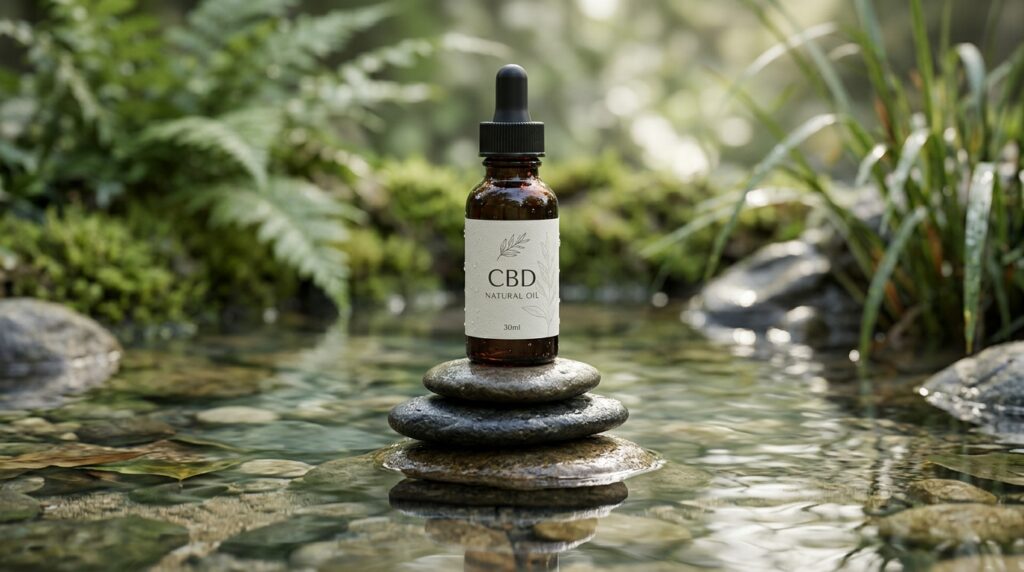
A shelf of small amber bottles looks simple from a distance. Up close, the labels promise calm, comfort, and balance, while the contents vary far more than the packaging suggests.
A short list of facts makes the decision easier. CBD oil is among the most searched wellness products in the United States, and a 2019 Gallup poll found that 14 percent of American adults said they used CBD products. That popularity brought a crowded market, uneven quality, and plenty of confusing claims, so a little groundwork pays off before any money changes hands.
What CBD Oil Actually Contains
The compound and the carrier
Cannabidiol, shortened to CBD, is one of more than 100 cannabinoids identified in the cannabis plant. Chemist Roger Adams isolated it in the early 1940s, and Israeli researcher Raphael Mechoulam worked out its structure in 1963. Unlike THC, CBD does not produce a high. Most commercial CBD oil is a hemp extract blended into a carrier oil such as MCT (medium-chain triglyceride) oil, olive oil, or hemp seed oil. The extract supplies the cannabinoids. The carrier makes the liquid easy to measure and easier for the body to absorb.
Hemp seed oil is a different product
Some bottles show “hemp oil” or “hemp seed oil” in large type and say nothing about cannabidiol. Hemp seed oil is pressed from the seeds, which hold only trace amounts of cannabinoids at most. It works as a cooking oil or skin moisturizer and usually costs far less than a true CBD product. A genuine CBD label names “hemp extract” or “full spectrum hemp extract,” or lists a milligram amount of CBD. When neither appears, the bottle is probably seed oil.
Where hemp and marijuana divide
Both come from Cannabis sativa. The 2018 Farm Bill, signed in December 2018, defined hemp as cannabis containing no more than 0.3 percent delta-9 THC by dry weight and removed it from the Controlled Substances Act. CBD derived from compliant hemp is no longer a federally controlled substance. CBD made from higher-THC marijuana stays under stricter rules and is sold mainly through state-licensed dispensaries.
What Regulators Have Said
One approved drug, many unapproved oils
In June 2018 the FDA approved Epidiolex, a purified CBD prescription medicine for seizures linked to Lennox-Gastaut syndrome and Dravet syndrome. Tuberous sclerosis complex was added in 2020. That approval covers one prescription product with a known dose. It does not extend to over-the-counter oils, and the FDA has stated that CBD cannot be legally added to food or sold as a dietary supplement under current law.
Gaps in oversight
Since no agency verifies potency before a bottle goes on sale, accuracy depends largely on the seller. The FDA sent warning letters to 15 companies in November 2019 over illegal marketing, and the Federal Trade Commission announced actions against six sellers in 2020 for unsupported health claims. A product that promises to cure a disease is breaking marketing rules regardless of how good the oil is.
State rules vary
Federal law sets a floor, and states add their own conditions. Some set minimum purchase ages, require product registration, or restrict CBD in food and drinks. A quick check of the state health department website takes a few minutes and prevents surprises, especially when ordering from an out-of-state retailer.
Checks Worth Making at the Shelf
A short buying checklist
A label that holds up usually shows most of the following:
- CBD listed in milligrams, for the whole bottle and per serving
- The phrase “hemp extract” rather than only “hemp seed oil”
- A batch or lot number
- A certificate of analysis from an independent lab, often reached by QR code
- A THC statement such as “less than 0.3 percent” or “non-detect”
- An expiration date, since most oils stay stable for roughly a year or two
Missing items are not proof of a bad product, but several gaps together are a reason to keep shopping.
Why labels deserve a second look
In a 2017 study in JAMA, researchers led by Marcel Bonn-Miller bought 84 CBD products sold online and tested them. About 31 percent matched their labels, roughly 43 percent held more CBD than stated, and about 26 percent held less. THC turned up in about 21 percent of the samples. The sample was small and dates from the early market, yet it explains why the certificate of analysis matters.
Price per milligram
A bottle priced at $60 with 1,500 mg of CBD costs $0.04 per milligram. A $30 bottle with 300 mg costs $0.10 per milligram, which makes the cheaper-looking bottle the pricier choice. Dividing the price by the total milligrams takes ten seconds with a phone calculator. Prices that sit far below the market average sometimes signal diluted product, so a very low number deserves a closer look at the lab report.
Safety Points Before the First Dose
Side effects seen in studies
Trials of Epidiolex reported sleepiness, reduced appetite, diarrhea, and raised liver enzymes. Those studies used doses of 10 to 20 mg per kilogram of body weight each day, which is much higher than what a typical retail serving delivers. Even so, they show that CBD is an active compound with real effects, and that unusual tiredness or stomach upset deserves attention.
Medication interactions
CBD can slow the liver enzymes that break down certain drugs, including CYP3A4 and CYP2C19. Documented concerns involve the seizure medicine clobazam and the blood thinner warfarin. The label on some medications carries a grapefruit warning, and that warning is a clue that CBD may interact as well. A pharmacist can check a medication list in a couple of minutes.
People who should wait
The FDA advises against CBD use during pregnancy and while breastfeeding. Children should use it only under a doctor’s direction, with Epidiolex as the one approved option. Anyone with liver disease should talk with a clinician first, since liver enzyme changes were the most notable lab finding in clinical trials.
Final Thoughts
CBD oil rewards buyers who read the label, check the lab report, and compare cost per milligram. A pharmacist or doctor can fill in the rest when medications or health conditions are involved.